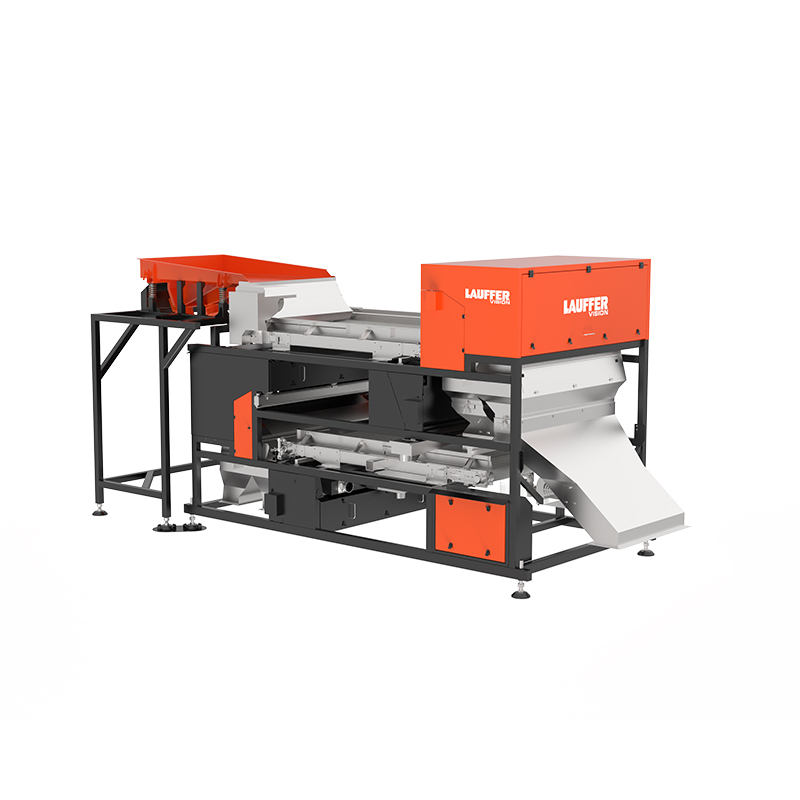
Aluminum recycling presents a sorting challenge where alloy identity and contamination level directly determine commercial value — Zorba, the mixed aluminum shredder product recovered from end-of-life sources, contains a complex mixture of wrought alloys, cast alloys, and heavy metal contaminants such as iron, zinc, and copper, all commingled in unpredictable proportions. For aluminum recyclers and secondary smelters, the ability to discriminate heavy metals from aluminum fractions and to separate wrought alloys from cast alloys — based on intrinsic material properties rather than unreliable visual cues — is the key to producing clean, alloy-specific aluminum output that commands premium market pricing and meets the exacting feedstock requirements of downstream remelting operations. Intelligent dual-sensor sorting is the key to transforming mixed Zorba into purified, high-value aluminum streams.
The Donar DE-XRT Pro Sorting System leverages the cutting-edge fusion of Dual-Energy X-ray Transmission (DE-XRT) and high-resolution RGB (HR-RGB) imaging technology powered by state-of-the-art AI algorithms to achieve precise recovery of aluminum fractions from material streams. By analyzing differences in atomic density, the system purifies aluminum alloys by discriminating heavy metals from Zorba — and delivers accurate separation of wrought aluminum from cast aluminum based on AI-driven surface feature analysis.
AI-driven surface feature recognition algorithms — trained on real-world production data using deep learning, with sorting precision refined continuously — ensure consistently high sorting accuracy across diverse Zorba compositions and contamination profiles — helping processors maximize alloy-specific recovery, eliminate heavy metal contamination, and deliver purified aluminum feedstock that meets the exacting standards of secondary smelting with unmatched confidence.
Sorting Principle of Donar DE-XRT Pro Sorting System
Purifying Aluminum from Zorba (Heavy Metal Impurity Removal)
The separation of aluminum from heavy metal impurities in Zorba is fundamentally based on the significant differences in atomic density.
When dual-energy X-rays penetrate the material stream, the system measures the attenuation differences between high-energy and low-energy X-rays. Aluminum is a light metal with a low atomic density, exhibiting weak X-ray attenuation. In contrast, heavy metal impurities such as copper, brass, zinc, and stainless steel possess significantly higher atomic densities, resulting in strong X-ray absorption. By calculating the Dual-Energy Ratio (DER), the system accurately determines the intrinsic atomic density of each particle, effectively eliminating the interference of material thickness. This allows the intelligent control system to precisely identify and trigger the pneumatic ejection of heavy metal contaminants, leaving behind purified aluminum fractions.
Separating Wrought Aluminum from Cast Aluminum
The separation between wrought aluminum and cast aluminum is primarily based on the subtle differences in atomic density and surface texture.
Although both wrought aluminum and cast aluminum are aluminum-based, cast aluminum (typically used in engine blocks, etc.) contains a higher proportion of silicon (Si). This results in an atomic density and X-ray absorption rate distinct from that of wrought aluminum (which typically has low silicon content). Leveraging the high-precision X-ray transmission technology, the system can identify and eject high-silicon, high-density cast aluminum particles, significantly reducing the high-silicon cast aluminum content in the material stream. Meanwhile, some cast aluminum alloys possess a density very similar to wrought aluminum, making them difficult to distinguish via X-ray transmission alone. However, cast aluminum surfaces typically exhibit specific textures, colors, or sheens (e.g., traces left by mold casting). By utilizing AI deep learning to detect minute visual features imperceptible to the human eye, the system can also precisely eject low-alloy cast aluminum that shares similar density but differs in material composition, serving as a complement to X-ray transmission and maximizing the value of the recycled aluminum stream. (At this stage, the material stream consists almost exclusively of wrought aluminum, though it may still contain a mix of different wrought alloy grades, the further separation will be implemented by the more advanced LIBS technology to achieve higher value.)
Technical Features
● Dual-Sensor Fusion Technology
The cutting-edge fusion of Dual-Energy XRT and high-resolution RGB imaging technology ensures aluminum purity by eliminating heavy metals via atomic density analysis, and accurately classifies wrought and cast aluminum by identifying their atomic density and surface texture.
● Proprietary AI Deep Learning Algorithms
Innovative simulation of manual picking operation by teaching and training the intelligent sorting system all the standards and features of identification and sorting. AI algorithms continuously improve sorting accuracy, with models retrained on new production samples via deep learning.
● Reliable High-Performance Air Ejector System
Powerful high-speed air ejectors designed and produced in-house ensure accurate rejection and reliable performance at high-capacity sorting
● Flexible Modular Design
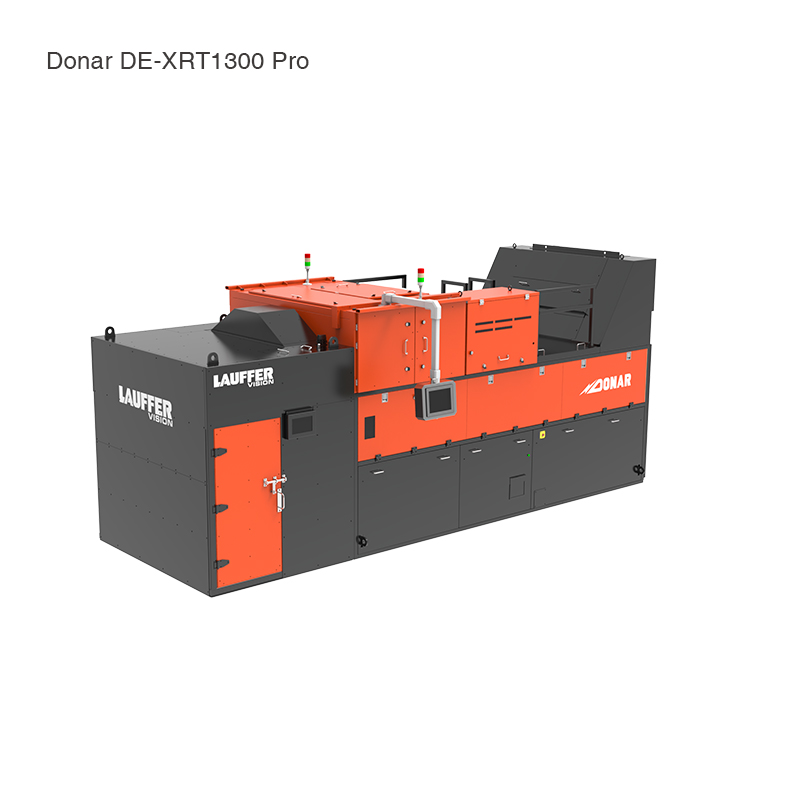
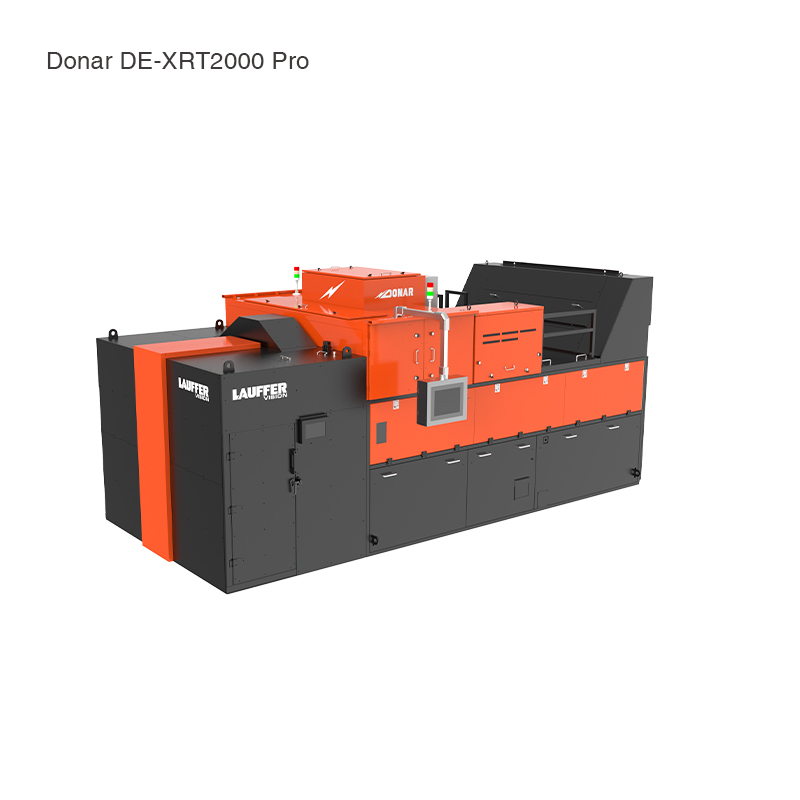
Typical Application ScenariosModular design of belt width from 1300 to 2000mm (1300/2000) provides processors more flexibility, ideal for auto dismantlers, aerospace aluminum recyclers, packaging material recyclers and IBA recyclers.
✦ Recovery of Aluminum Scrap
✩ Building Window/Door Recycling
✩ Beverage Can Recycling
✩ E-Waste Aluminum Recycling
✦ Separation of Cast Aluminum and Wrought Aluminum
✩ Auto Shredder Residue Sorting
✩ Industrial Machinery Scrap
✩ Aerospace Aluminum recycling
✩ Consumer Electronics Housing
✦ Recovery of Stainless Steel
✩ IBA (Incinerator Bottom Ash) Recycling
Specifications✩ ASR (Automotive Shredder Residue) Recycling
| Model | Donar DE-XRT1300 Pro |
Donar DE-XRT2000 Pro |
|
Belt Width (mm) |
1300 | 2000 |
|
Inspection Width(mm) |
1200 | 1800 |
|
Air Nozzle |
202 | 304 |
|
Sorting Size (mm) |
10~80 |
10~80 |
|
Throughput (t/h) |
4~10 |
6~16 |
|
Air Consumption (m3/min) |
15 | 15 |
|
Power (kW) |
12 | 15 |
|
Dimension (mm) |
5,675×2,436×2,349 |
5,593×2,770×2,703 |
|
Unpacked Weight (t) |
5.8 | 8.7 |
Specifications are approximate and subject to change without notice. Lauffer Vision reserves all rights for modifications.