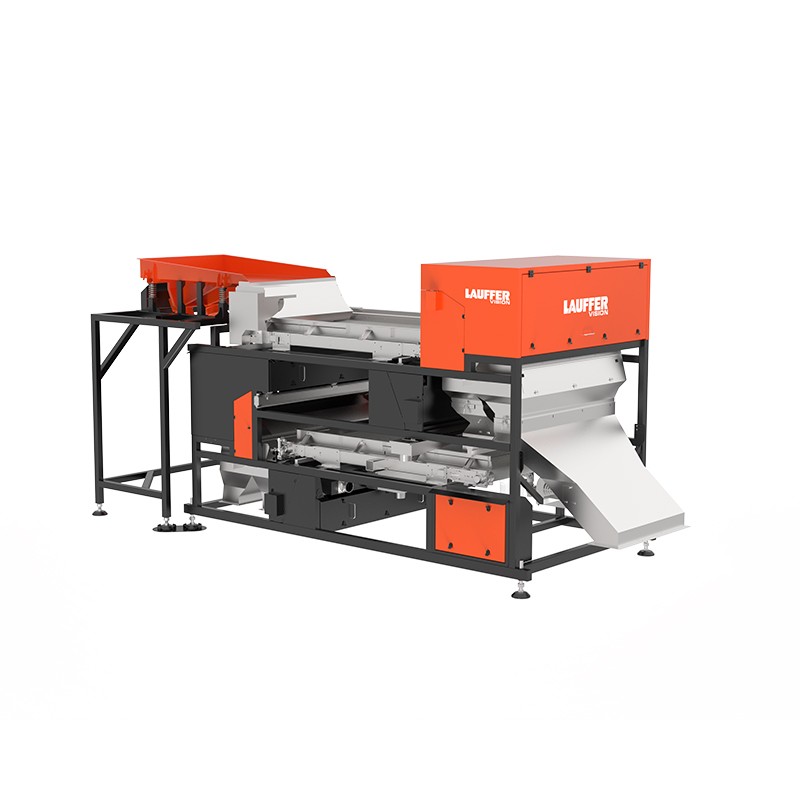
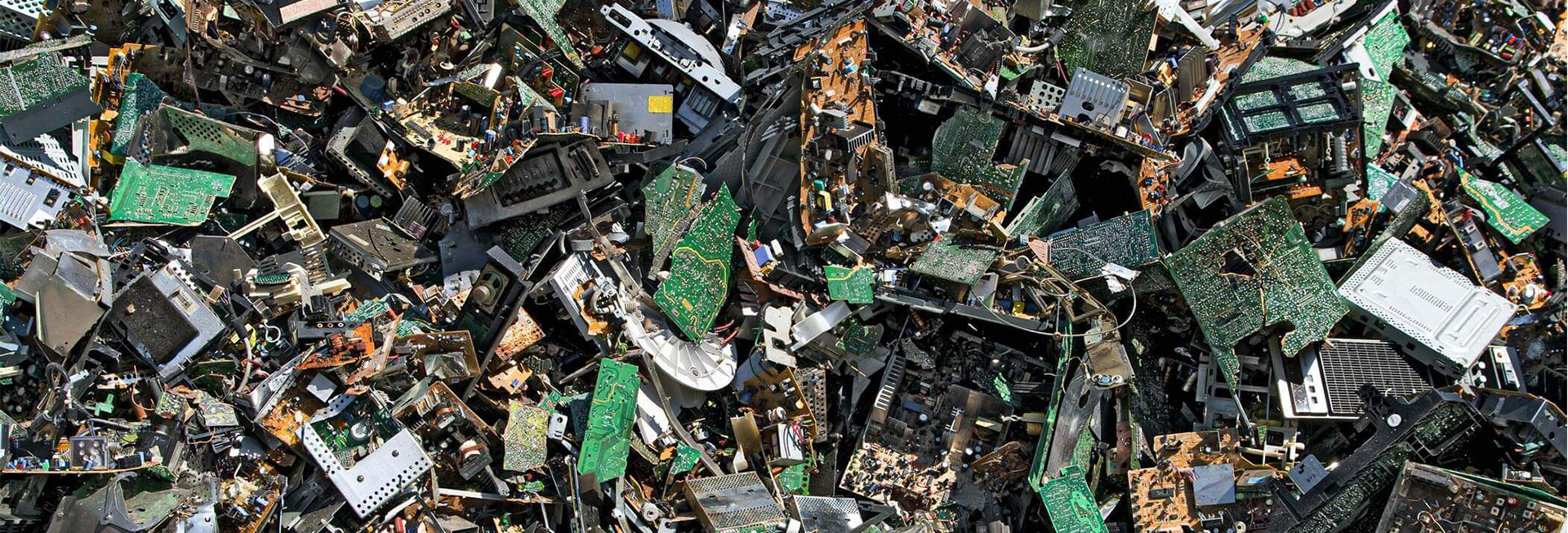
E-scrap shreds present a sorting challenge where material value is locked beneath the surface — high-value fractions such as copper, aluminum, and precious metals are embedded within dense, heterogeneous waste streams alongside plastics and inert matter, making surface-only identification fundamentally insufficient. For e-scrap recycling operations, the ability to see beyond surface appearance and accurately identify materials by their internal composition is the key to recovering maximum value from every shred — reducing reliance on costly manual sorting, improving resource recovery rates, and transforming complex e-waste into clean, high-value material streams. Intelligent dual-sensor sorting is the key to unlocking what conventional systems cannot detect.
The Donar DE-XRT Pro Sorting System leverages the cutting-edge fusion of Dual-Energy X-ray Transmission (DE-XRT) and high-resolution RGB (HR-RGB) imaging technology powered by state-of-the-art AI algorithms to achieve precise recovery of high-value fractions from e-scrap shreds. By measuring the differential X-ray attenuation of materials at two energy levels, combined with surface feature analysis via RGB imaging, the system efficiently identifies and recovers metals (e.g., copper, aluminum, precious metals), plastics, and other high-value fractions — improving resource recovery rates while reducing manual sorting costs.
AI-driven surface defect recognition algorithms — trained on real-world production data using deep learning, with sorting precision refined continuously — ensure consistently high sorting accuracy across diverse e-scrap compositions and shred conditions — helping processors maximize high-value material recovery, minimize manual labor dependency, and deliver clean, market-ready output streams with unmatched confidence.
Two X-ray Energy Levels:
Low-Energy X-Ray (20-50 keV)
High-Energy X-Ray (80-150 keV)
Plastic
✦ High absorption at low energy (low transmission)
✦ Low absorption at high energy (high transmission)
✦ DER < 1.5
Aluminum
✦ Moderate absorption at low energy (medium transmission)
✦ Low absorption at high energy (high transmission)
✦ DER: 1.5-2.5 (between plastic and copper)
Copper
✦ Very high absorption at low energy (low transmission)
✦ Moderate absorption at high energy (medium transmission)
✦ DER > 2.5
Silver
✦ Extremely high absorption at low energy (very low transmission)
✦ Moderate absorption at high energy (medium transmission)
✦ DER: 3.0-4.0
Gold
✦ Almost complete absorption at low energy (near-zero transmission)
✦ High absorption at high energy (low transmission)
✦ DER > 5.0
Donar DE-XRT Pro Sorting System accurately distinguishes different materials in e-scrap shreds based on their differences in DER and surface feature.
Technical Features
● Dual-Energy X-ray & High-Resolution RGB Fusion
Market-leading dual-sensor fusion combines differential X-ray attenuation with high-resolution surface feature analysis — delivering high-precision identification and separation of copper, aluminum, and precious metals in e-scrap shreds, even in heavily contaminated and compositionally unpredictable feed streams.
● Deep Learning Algorithms Trained on Production Data
AI-driven defect recognition algorithms, trained on real-world production data via deep learning, replicate and exceed manual picking accuracy — and continuously improve through iterative model retraining, maintaining consistently high sorting performance as e-scrap compositions and contamination profiles evolve.
● Reliable High-Performance Air Ejector System
Powerful high-speed air ejectors designed and produced in-house ensure accurate rejection and reliable performance at high-capacity sorting.
● Flexible Options for Different Throughput Requirements
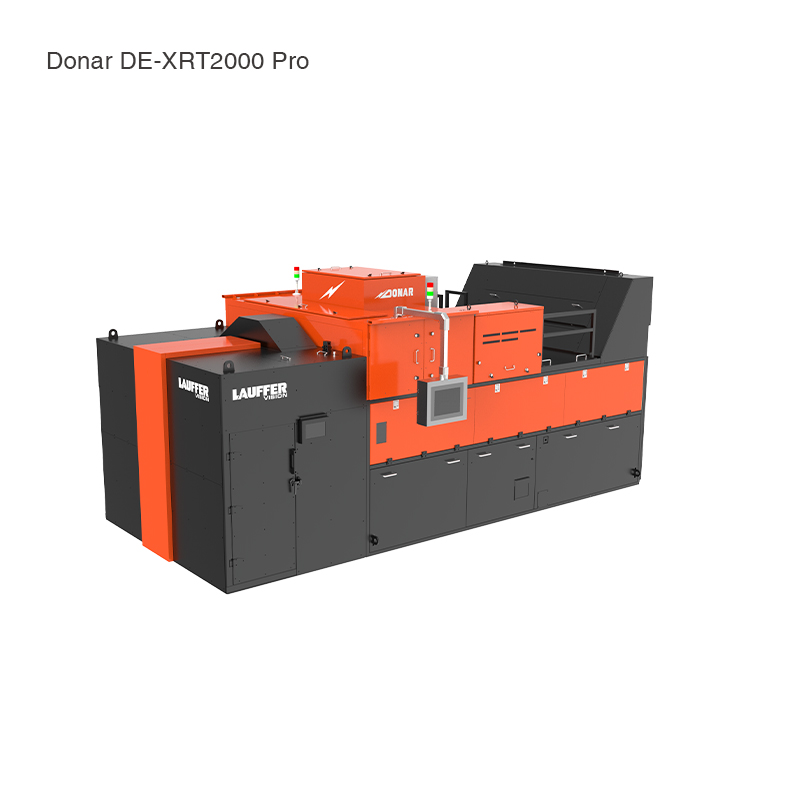
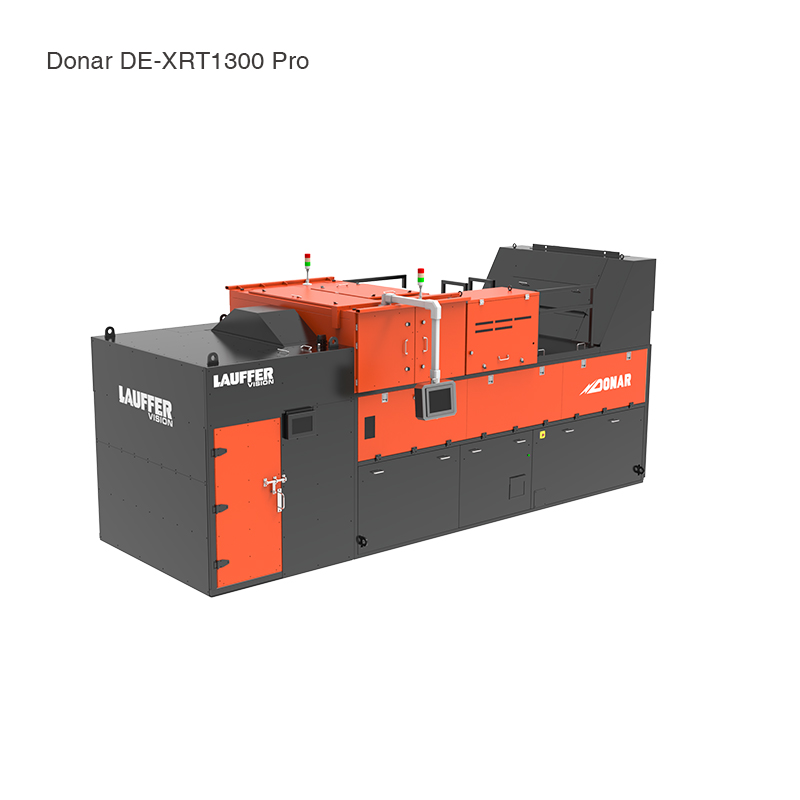
Available in two models with belt widths of 1300 mm and 2000 mm, providing processors greater flexibility to match different throughput requirements.
Typical Applications
✦ Printed Circuit Board (PCB) Sorting
Identification and separation of copper, aluminum, gold, silver and plastic substrates in PCBs
✦ Electronic Component Recycling
Recovery of precious metals from resistors, capacitors, connectors, etc.
✦ Waste Cable Processing
Separation of copper/aluminum cores from insulation layers (PVC/PE)
Specifications
| Model | Donar DE-XRT1300 Pro |
Donar DE-XRT2000 Pro |
|
Belt Width (mm) |
1300 | 2000 |
|
Inspection Width(mm) |
1200 | 1800 |
|
Air Nozzle |
202 | 304 |
|
Sorting Size (mm) |
10~80 |
10~80 |
|
Throughput (t/h) |
4~10 |
6~16 |
|
Air Consumption (m3/min) |
15 | 15 |
|
Power (kW) |
12 | 15 |
|
Dimension (mm) |
5,675×2,436×2,349 |
5,593×2,770×2,703 |
|
Unpacked Weight (t) |
5.8 | 8.7 |